
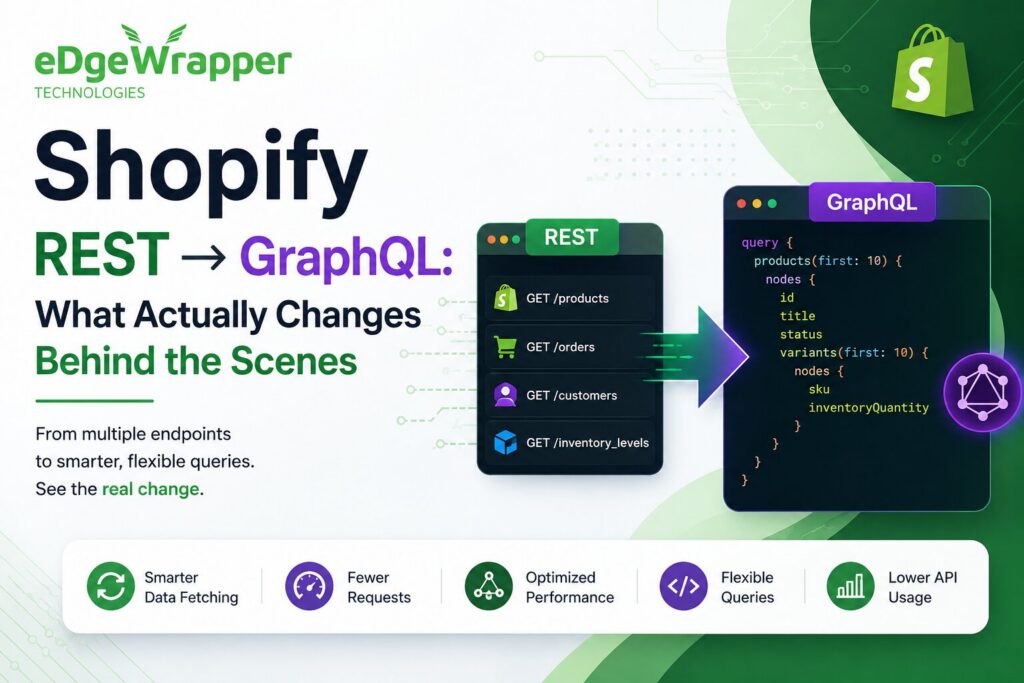

Shopify REST → GraphQL
What Actually Changes Behind the Scenes
For years, REST APIs have been the default way to connect ecommerce platforms with applications, automation systems, and external services. Shopify has supported REST APIs extensively, making it straightforward to retrieve products, orders, customers, inventory, and other store data.
Migration REST → GraphQL
API Architecture
Data Modeling
Automation
But ecommerce integrations are becoming more complex. A single Shopify store can have thousands of products, multiple inventory locations, large order histories, multiple apps, and several connected systems. As the amount of data grows, traditional REST-based integrations can start making more API calls than necessary.
This is where GraphQL changes the integration model.
Moving from Shopify REST to GraphQL is not simply replacing one URL with another. It changes how applications request data, how responses are structured, how integrations manage API usage, and how ecommerce automation should be designed.
The simplest way to understand the difference is to look at how data is requested.
GET /orders
GET /customers
GET /inventory_levels
Each endpoint represents a specific resource.
products(first: 10) {
nodes {
id
title
status
}
}
}
The server returns the fields requested by the client.
REST tells the API which resource you want. GraphQL tells the API which data you want.
Store Data
Request
Optimized Response
One query · Exact data · No over-fetching
Consider an ecommerce automation system that needs to display:
•Product title
•Product status
•Variant SKU
•Inventory quantity
•Product images
With a REST-based approach, the integration may need to retrieve products and then make additional requests for related information depending on the API structure and implementation.
products(first: 10) {
nodes {
id
title
status
variants(first: 10) {
nodes {
id
sku
inventoryQuantity
}
}
}
}
}
GraphQL allows the application to describe the required data structure in one query. The response is structured around the exact information requested. For an automation platform, this can significantly simplify data retrieval.
REST integrations are built around endpoint management. GraphQL moves this complexity into the query itself.
With GraphQL, the client can request only the required fields, reducing unnecessary data transfer.
GraphQL represents relational data directly in the query, making complex workflows easier to model.
GraphQL responses mirror the query structure, making them predictable and self-describing.
GraphQL separates read (queries) and write (mutations) operations explicitly.
Cursor-based pagination remains essential for large datasets. Poor pagination still hurts performance.
Shopify GraphQL uses a query cost model. Deeply nested queries can be expensive.
Poorly designed GraphQL queries can request too much data. Optimization still matters.
GraphQL adds an integration layer for data normalization and automation orchestration.
GraphQL responses can contain both data and errors. Integrations must handle both properly.
GraphQL and webhooks solve different problems. A scalable architecture uses both.
GraphQL supports bulk-operation patterns for large data workloads like migrations and analytics.
| Area | REST | GraphQL |
|---|---|---|
| Data access | Resource-based | Query-based |
| Endpoints | Multiple | Primarily GraphQL endpoint |
| Data selection | Server-defined response | Client selects fields |
| Related data | Often multiple requests | Can be nested in query |
| Over-fetching | More common | Easier to control |
| Pagination | Supported | Cursor-based patterns |
| API optimization | Request-focused | Query-cost focused |
| Writes | REST methods | Mutations |
| Error handling | HTTP + API errors | HTTP + GraphQL errors |
| Large datasets | Pagination/batch strategies | Pagination + bulk patterns |
A REST-to-GraphQL migration should not start with “Let’s convert every API call.” It should start with “Which workflows are creating unnecessary complexity or API usage?”
- •REST endpoints currently used
- •API frequency and dependencies
- •Repeated requests and pagination
- •High-volume workflows
- •REST Product API → GraphQL Product Query
- •REST Product Update → GraphQL Product Mutation
- •Migrate business workflows, not endpoints
- •Build queries around actual requirements
- •Request only needed fields
- •Design for workflow efficiency
- •API usage and query costs
- •Response time and error rates
- •Workflow completion time

For businesses operating across multiple ecommerce platforms, API integration is rarely just about Shopify.
•Amazon
•Flipkart
•Magento
•WooCommerce
•ERP
•CRM
•Warehouse
•Payment Systems
Each platform has different APIs, data models, authentication systems, and operational requirements. This is where an integration and automation layer becomes valuable.
│
├── Amazon
Business Data ───┼── Magento
│
├── WooCommerce
│
└── Other Systems
↓
Integration Layer
↓
Automation Workflows
↓
Business Applications
The goal is to abstract platform-specific API complexity while keeping the business workflow consistent. For EdgeWrapper, this is the broader opportunity: commerce engineering is not just about connecting APIs. It is about turning fragmented ecommerce systems into coordinated business operations.
The transition from Shopify REST to GraphQL is more than an API upgrade. It changes how developers think about ecommerce data.
REST encourages an endpoint-oriented mindset: “Which resource should I request?”
GraphQL encourages a data-oriented mindset: “What information does this workflow actually need?”
That difference becomes increasingly important as ecommerce operations grow.
For small integrations, REST may still be perfectly adequate. For complex Shopify applications, high-volume automation, data-heavy dashboards, and multi-platform commerce systems, GraphQL provides a more flexible foundation for designing data access around actual business requirements.
The real value is not simply fewer API calls. It is building an integration architecture where data retrieval, automation, and business workflows are designed together. That is where the shift from REST to GraphQL becomes more than a technical migration—it becomes an opportunity to rethink how ecommerce systems operate.
EdgeWrapper specializes in building connected commerce infrastructure and automation solutions. Our Commerce Engineering approach helps businesses centralize operations, synchronize data across platforms, and automate workflows for scalable multi-channel growth.
Build scalable, data-driven Shopify integrations with EdgeWrapper’s Commerce Engineering approach.
API architecture — built for scale.

The variety of options here is just insane. I love how everything loads so quickly without any lag. Give brwinxx a try if you want a reliable platform.
Finally a platform where the login is actually stable. No more annoying crashes when I am on a winning streak. Great job kkjililogin.
The graphics are top notch and the gameplay is so immersive. Really enjoying my time on phjili12.