

edgewrapper
Commerce Engineering
Ecommerce businesses rarely operate from a single platform. A growing business may manage products through one system, sell through Shopify, Amazon, Flipkart, WooCommerce, and Magento, process orders through another application, and coordinate delivery through a separate workflow. As the number of platforms increases, keeping product information, inventory, pricing, orders, customers, and fulfillment data synchronized becomes a major operational challenge.
This is where EdgeWrapper’s Commerce Engineering & Automation approach comes in.
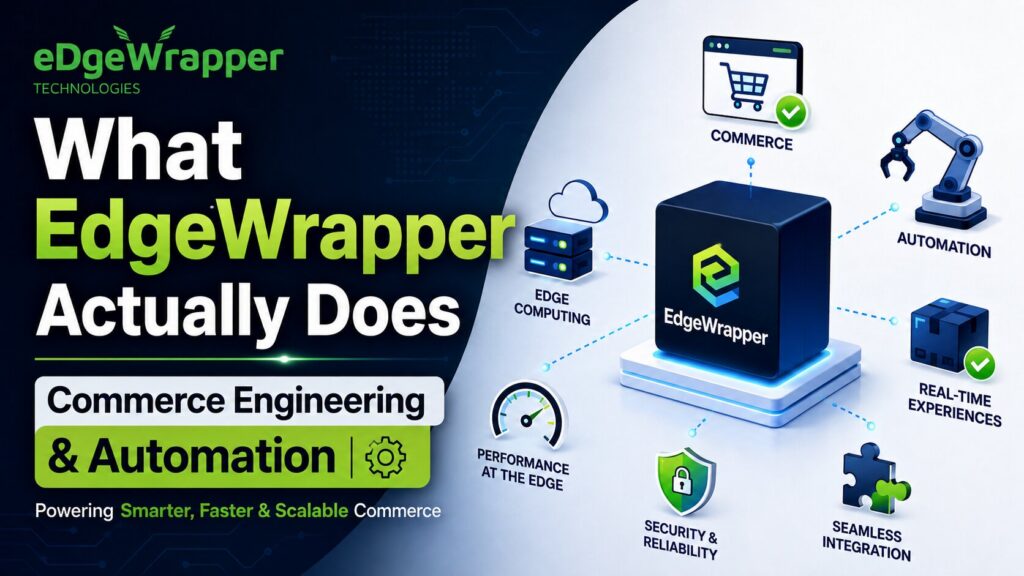
Rather than building isolated integrations for individual platforms, EdgeWrapper creates a connected commerce infrastructure where a central master system acts as the operational source of truth, while multiple ecommerce platforms can be synchronized and managed through automated workflows.
The Challenge
The Business Problem: Ecommerce Operations Become Complex at Scale
Managing multiple marketplaces manually creates recurring problems:
Manual product updates across platforms
Inventory sync delays cause overselling
Inconsistent pricing across channels
Manual order consolidation
Disconnected fulfillment operations
No single source of truth
For a business operating across Shopify, Amazon, Flipkart, WooCommerce, Magento, and other channels, these challenges grow rapidly with every additional platform. The result is often more manual work, higher operational costs, delayed processing, and a greater possibility of data inconsistency.
Our Approach
Build a Master Commerce Layer
Instead of treating every ecommerce platform as a separate operational system, we establish a central master commerce layer that brings business data together and coordinates communication with connected platforms.
Multiple Commerce Platforms → Master System → Automated Platform Operations
The master system can receive and maintain information such as:
Product details
Product images
Inventory
Pricing
Categories
Product attributes
Orders
Customer operational data
Shipment and fulfillment
Once the data is available in the master system, automated workflows can distribute relevant information to connected ecommerce platforms. This creates a more controlled and consistent way to operate a multi-channel ecommerce business.
Master Data Layer
One Master Data Layer, Multiple Sales Channels
One of the key capabilities we build is master table synchronization.
For example, a business may upload or maintain product information in its master module. Instead of manually updating that product on every marketplace, the automation layer can use the master data to manage the connected channels.
Product Data → Master Module → Validation & Transformation → Platform APIs → Shopify / Amazon / Flipkart / WooCommerce / Magento
When product information changes, the system can identify the relevant platform operations and synchronize the required information. This allows businesses to move from “Update every platform manually” to “Manage the core data centrally and automate the platform updates.”
Platform Management
Managing Multiple Ecommerce Platforms From One System
EdgeWrapper has worked on automation for platforms including Shopify, Flipkart, Amazon, WooCommerce, and Magento.
Each platform has its own APIs, data structures, business rules, and operational workflows. A product structure that works for one marketplace may need to be transformed before it can be submitted to another.
This is why ecommerce automation is not simply about connecting APIs. It requires a layer that can handle:
Data mapping
Validation
Platform transformations
API communication
Error handling
Synchronization
Workflow orchestration
Status tracking
Our automation layer is designed around these requirements. The goal is to make the complexity of individual platform integrations less visible to the business team.
Platform Automation
Shopify · WooCommerce · Magento · Amazon · Flipkart Automation
S
Shopify
»
Centralized product & inventory sync
»
Automated order processing
»
Multi-channel data sync
W
WooCommerce
»
Product & inventory sync
»
Order processing automation
»
Payment & fulfillment sync
M
Magento
»
Catalog & inventory management
»
Order & customer automation
»
Enterprise workflow orchestration
F
Flipkart
»
Product listing & inventory sync
»
Shipment & cancellation handling
»
Sales & return analytics
A
Amazon
»
Product & inventory sync
»
Order & fulfillment automation
»
Marketplace workflow integration
The important principle remains the same: Centralize the business logic, then connect the required commerce channels. This makes it easier to build an architecture that can support additional channels without redesigning the entire operational process.
Fulfillment
Automated Delivery and Fulfillment Workflows
Commerce automation does not stop when an order is created.
After an order arrives, businesses still need to manage fulfillment, shipment processing, delivery-related operations, cancellations, returns, and status updates. EdgeWrapper also works on delivery automation, allowing fulfillment-related processes to become part of the larger ecommerce workflow.
Order Received → Order Validation → Fulfillment Processing → Delivery Workflow → Status Update
By connecting order and delivery operations, businesses can reduce the amount of manual coordination required after an order is placed.
Commerce Engineering
From API Integration to Commerce Engineering
There is an important difference between simply integrating an API and building an ecommerce automation system.
An API integration connects two systems. Commerce engineering connects business processes.
For example, a basic integration might simply transfer a product from one system to another. A commerce automation architecture needs to answer much more:
What is the master product record?
Which platform should receive the product?
How should the product data be transformed?
What happens if a platform rejects the data?
How should inventory changes propagate?
How should orders move through the workflow?
How should fulfillment status be synchronized?
How can the architecture scale as platforms are added?
This is where engineering becomes more important than simply writing API connectors.
Architecture
A Connected Commerce Architecture
Business Data Layer
Centralized products, inventory, pricing, orders, and operational records.
Automation & Orchestration Layer
Validation, mapping, transformation, workflow management, and synchronization.
Commerce Integration Layer
Platform-specific connectors and APIs for Shopify, WooCommerce, Magento, Amazon, Flipkart.
Commerce Channels
Shopify, WooCommerce, Magento, Amazon, Flipkart, and other supported platforms.
Fulfillment & Delivery Layer
Order processing, shipment workflows, delivery operations, and status synchronization.
This architecture gives businesses a foundation that can evolve as their commerce ecosystem grows.
Business Impact
What This Means for the Business
The value of ecommerce automation is not simply fewer API calls or fewer manual clicks. The larger business impact is operational.
1
One Source of Truth
Core business data maintained centrally across all platforms.
2
Better Data Consistency
Changes synchronized through controlled workflows across all channels.
3
Reduced Manual Operations
Teams spend less time on repetitive data entry across platforms.
4
Faster Order Processing
Automated workflows from order creation to fulfillment completion.
5
Easier Multi-Channel Management
Manage all commerce channels through a connected operational architecture.
6
Scalable Operations
The automation layer evolves as you add marketplaces, products, and workflows.
Perspective
The EdgeWrapper Perspective
At EdgeWrapper, we see ecommerce automation as more than connecting Shopify, Amazon, Flipkart, WooCommerce, or Magento.
The real objective is to engineer the operational layer behind commerce.
A business should be able to maintain its core information once and use automation to distribute, synchronize, process, and manage that information across the systems that matter.
Master data sync
Multi-platform product management
Shopify automation
WooCommerce automation
Magento automation
Amazon automation
Flipkart automation
Inventory sync
Order processing
Delivery automation
Fulfillment workflows
Marketplace operations
The architecture should be built around the business process—not around a single API.
Conclusion
Building the Next Layer of Ecommerce Operations
As ecommerce businesses expand across marketplaces and sales channels, operational complexity becomes one of the biggest barriers to growth.
The answer is not necessarily adding more people to perform repetitive tasks. The better approach is to build systems that can connect data, automate workflows, and allow people to focus on business decisions instead of repetitive operations.
That is what EdgeWrapper’s Commerce Engineering & Automation is designed to deliver.
One master data layer. Multiple commerce channels. Automated operations. Connected fulfillment. The goal is simple: make complex ecommerce operations easier to manage, scale, and automate.
About EdgeWrapper
EdgeWrapper specializes in building connected commerce infrastructure and automation solutions. Our Commerce Engineering approach helps businesses centralize operations, synchronize data across platforms including Shopify, WooCommerce, Magento, Amazon, and Flipkart, and automate workflows for scalable multi-channel growth.

Just joined a few days ago and I am already loving the vibe. The welcome bonus was a nice touch and everything feels very transparent at cv777game.