

Orchestration
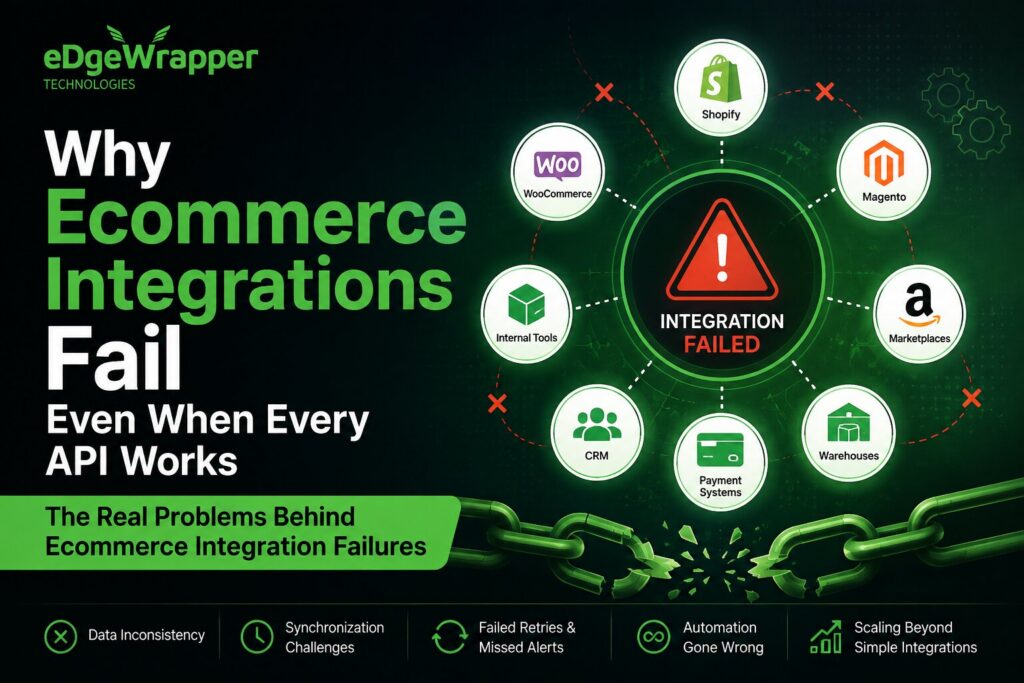
Why Ecommerce Integrations Fail
Even When Every API Works
Ecommerce businesses rarely struggle because an API is completely broken. More often, the APIs are working exactly as designed — products are syncing, orders are being created, inventory endpoints are responding, and customer data is moving between systems.
Challenge Orchestration
Business Process
Orchestration
Automation
Yet the business still experiences delays, incorrect inventory, duplicate orders, failed updates, manual work, and operational confusion.
That is the real integration problem.
An integration can be technically successful while being operationally broken. For growing ecommerce businesses, connecting Shopify, WooCommerce, Magento, marketplaces, warehouses, payment systems, CRMs, and internal tools is not simply an API problem. It is a business process and orchestration problem.
An API knows how to create an order, update inventory, retrieve a product. It does not understand what should happen when an order moves through your business.
Different platforms represent information differently. Every system has valid data, but the systems disagree with each other.
Distributed ecommerce systems rarely update at exactly the same time. This requires event handling, conflict management, retries, and state management.
Without proper failure handling, a temporary API problem can become a permanent business problem.
Poorly designed automation can create duplicate records, infinite update loops, incorrect inventory changes, and conflicting workflows.
The original integration was not necessarily badly built. The business simply became more complex with multiple storefronts, warehouses, and marketplaces.
Not just another API connector
The answer is not simply “connect more APIs.” Businesses need an integration layer that understands how their systems work together.
Instead of treating each API connection as an isolated project, EdgeWrapper focuses on the business workflow that sits between systems.
Instead of multiple independent connections, use a controlled layer where business rules, transformations, and workflow logic live.
Handle the difference between how different platforms represent the same business information.
Turn integration into a business workflow rather than a collection of API calls.
Ensure a temporary API failure does not silently become an operational issue.
Retrieve only the required data to reduce unnecessary API traffic and improve response times.
Connect Shopify, WooCommerce, Magento, Amazon, Flipkart, and internal systems through reusable integration capabilities.
A successful ecommerce integration should answer business questions, not just API questions.
These are not API questions. They are business operation questions.
This creates a foundation that can evolve as the business grows.
Better ecommerce integration is not just a technical improvement. It directly affects the business.
Fewer Manual Tasks
Teams spend less time copying information between systems.
Faster Operations
Orders, inventory, and product information move through workflows without unnecessary manual intervention.
Better Visibility
Operations teams can understand where a process is failing instead of discovering problems after customers are affected.
Easier Scaling
Adding another marketplace, warehouse, or commerce platform becomes a structured integration exercise.
Lower Operational Risk
Retries, validation, monitoring, and workflow controls reduce the risk of small technical failures becoming major business issues.
Connected Operations
Platforms, data, workflows, and business rules work together as one cohesive system.
Ecommerce integration does not fail because APIs don’t work.
It fails when businesses mistake API connectivity for operational integration.
Connecting two systems is relatively easy. Making those systems work together reliably — while handling different data structures, failures, business rules, inventory changes, scale, and future growth — is the real challenge.
That is where an orchestration and automation layer becomes valuable.
EdgeWrapper helps businesses build that layer. The goal is not simply to connect more platforms. The goal is to create a commerce operation where platforms, data, workflows, and business rules work together as one system.
Because the future of ecommerce integration is not more APIs. It is better orchestration.
EdgeWrapper specializes in building connected commerce infrastructure and automation solutions. Our Commerce Engineering approach helps businesses centralize operations, synchronize data across platforms, and automate workflows for scalable multi-channel growth.
Move beyond API connectivity to reliable, scalable business operations with EdgeWrapper’s Commerce Engineering.
Better orchestration — built for scale.

Honestly, I’ve tried a few sites recently but this one is surprisingly smooth. The payouts are fair and the games load fast. Definitely my new favorite spot! Check it out at gbo303slot
Love the variety of games available here. jili90casino always keeps things exciting with their latest updates.