
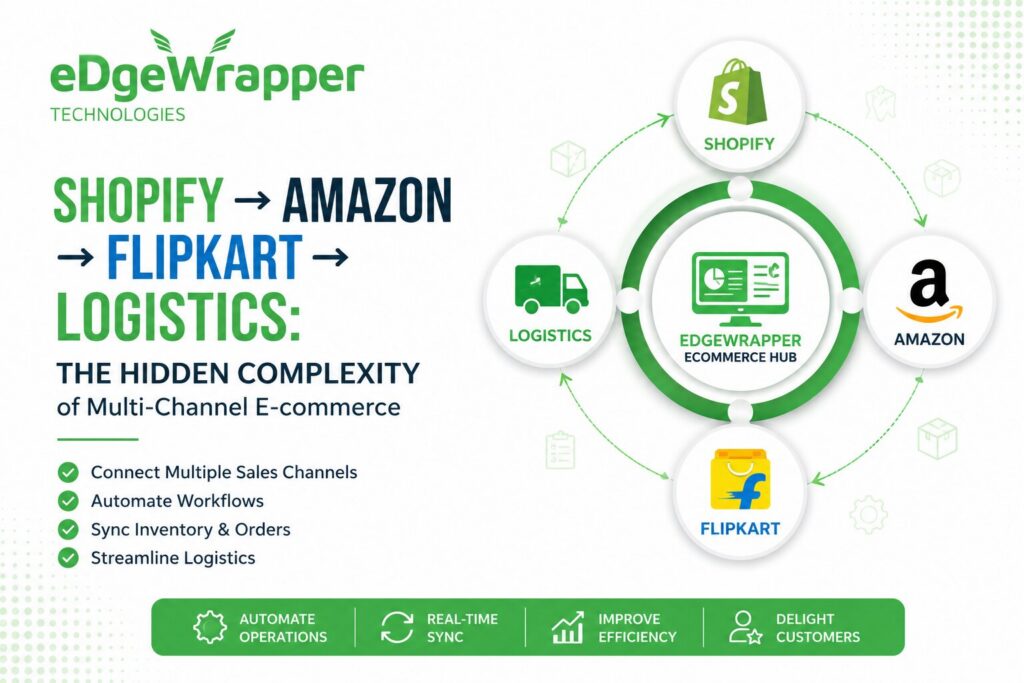

A business can launch a Shopify store, list products on Amazon, expand to Flipkart, and connect a logistics partner in a matter of weeks. But behind every online order sits a chain of interconnected operations:
Product → Channel → Inventory → Order → Fulfillment → Logistics → Delivery → Returns
The real question is no longer “how do we sell on Amazon, Flipkart and Shopify?” — it’s “how do we operate all these channels as one connected business?”
The Multi-Channel Ecommerce Reality
Shopify is the foundation of most direct-to-consumer brands. Amazon opens a massive marketplace audience. Flipkart adds another key channel. Logistics partners make fulfillment possible. Each platform plays its own role — but operationally, they are deeply connected.
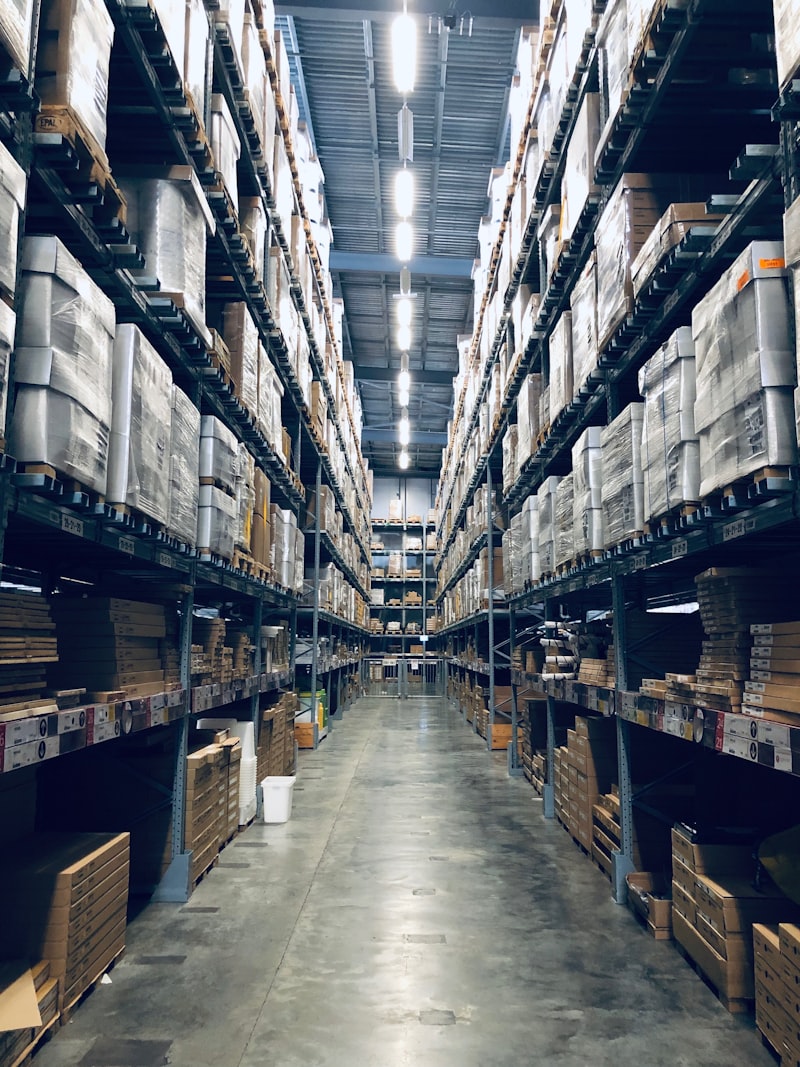
A simple example
A business holds 100 units of a product, listed on Shopify, Amazon, and Flipkart. A customer buys one unit on Amazon — inventory drops to 99.
That single Amazon order must now sync inventory everywhere, move through fulfillment and logistics, return tracking data to the right channel, and be ready to reverse itself if the order is cancelled or returned. What looks like one order to the customer touches multiple systems behind the scenes.
More Sales Channels Mean More Operational Dependencies
Every new marketplace introduces its own rules — different SKU structures, inventory logic, order formats, cancellation policies, and APIs. As channels multiply, so does the number of processes that must stay in sync — which is why “managing operations” quietly becomes a bigger challenge than acquiring customers.
SKU Structures
Inventory Rules
Order Formats
Return Processes

Product Data Is the First Layer of Complexity
Before a product can sell anywhere, it needs consistent names, descriptions, images, SKUs, variants, pricing, and tax data across every platform. For 20 products, that’s manageable by hand. For 2,000 products with multiple variants, updating a single price change across every channel becomes a major operational burden.
A product can end up with one price on Shopify, another on Amazon, and an outdated listing on Flipkart. The customer sees the inconsistency — the business absorbs the operational cost.
SKU Management Becomes a Business Problem
SKUs are the language connecting products across ecommerce systems — but every platform can use different identifiers or formats. A single variant like “Cotton Shirt – Blue – Medium” needs to map correctly everywhere it appears, or problems surface in:
✓ Inventory
✓ Orders
✓ Fulfillment
✓ Returns
Inventory Is Where Multi-Channel Complexity Becomes Visible
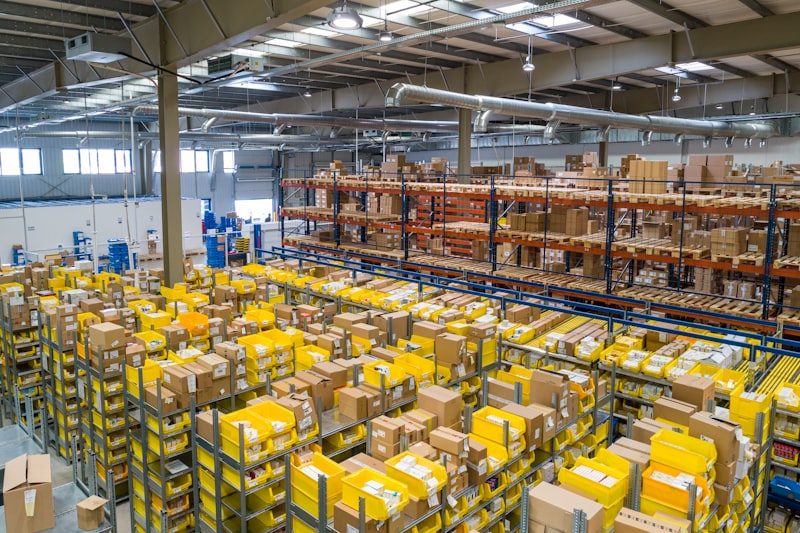
If a brand’s 50 available units aren’t synchronized the moment one platform sells 10, the business runs into real, customer-facing problems:
Overselling
Customers purchase products that are no longer available.
Stockouts
Listings stay visible even when the warehouse is short.
Cancellations
The business accepts orders it cannot fulfill.
Manual Reconciliation
Teams spend hours comparing reports to warehouse stock.
Orders Create the Next Layer of Complexity
Every order moves through a lifecycle — and cancellations, failed deliveries, and exchanges complicate it further. Every channel represents these statuses differently, so a business needs more than a dashboard; it needs a way to manage the movement of order information between systems.
Order Received
→
Validated
→
Inventory Confirmed
→
Fulfillment
→
Shipment
→
Delivery

Logistics Is Not a Separate Process
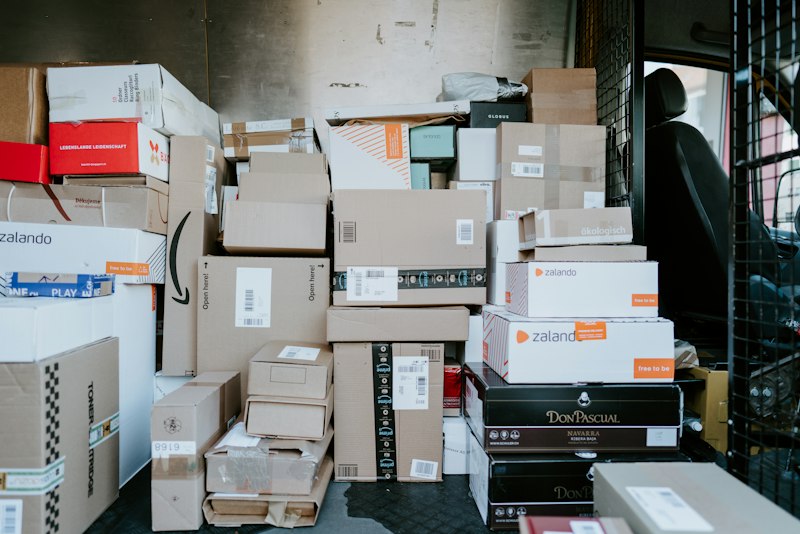
One of the biggest misconceptions in ecommerce is treating logistics as something that happens after the sale. In reality, it’s part of the commerce workflow itself:
1. Identify fulfillment location
2. Confirm inventory
3. Prepare shipment
4. Select logistics partner
5. Generate shipping info
6. Dispatch package
7. Capture tracking
8. Update sales channel
9. Monitor delivery
10. Handle returns
Returns Complete the Loop
The ecommerce journey doesn’t end at delivery. A returned product moves through its own cycle — and a disconnected return process can create problems across inventory, revenue, customer service, logistics, warehousing, and accounting all at once.
Return Request
→
Approval
→
Reverse Pickup
→
Warehouse Receipt
→
Inspection
→
Refund / Replacement
The Real Problem: Fragmented Operations
Shopify is powerful. Amazon is powerful. Flipkart is powerful. Logistics platforms are powerful. The challenge comes from operating them as disconnected systems — teams bouncing between dashboards, spreadsheets, and portals just to keep the business in sync.
Shopify Dashboard → Amazon Seller Central → Flipkart Seller Hub → Logistics Portal → Spreadsheet → Internal System
Every manual handoff introduces friction. This creates an operating model where the business grows by adding more people to coordinate more systems — and that’s difficult to scale.
Integration vs. Automation: An Important Difference
Integration is an important first step — it lets systems talk to each other. But communication alone doesn’t create an efficient operation.
Integration
Connects systems. Moves data — like order details — from one platform to another.
Automation
Connects processes. Defines what should happen next — validation, fulfillment, tracking, updates — without manual triggers.

What Businesses Actually Need Is an Operational Layer
Instead of treating Shopify, Amazon, Flipkart, and logistics as separate systems, think of them as components of one connected operating ecosystem:
Commerce Channels
Shopify · Amazon · Flipkart · Other Marketplaces
↓
Operational Layer
Products · Inventory · Orders · Fulfillment
↓
Logistics
Shipping · Tracking · Delivery · Returns
How EdgeWrapper Helps Connect the Ecommerce Ecosystem
EdgeWrapper approaches ecommerce operations from an automation-first perspective. Instead of treating each platform as an isolated integration, EdgeWrapper helps businesses connect commerce channels and operational processes through a centralized automation layer — Ecommerce Hub.
Shopify
Amazon
Flipkart
WooCommerce
Magento
Logistics Ops


Why This Matters as Ecommerce Businesses Scale
At low volumes, manual work is manageable. As order volume climbs, the same process becomes a bottleneck — and it’s not just orders that multiply, it’s every operational event around them.
20
orders/day
→
100
orders/day
→
500
orders/day
→
1,000+
orders/day
Better Operations Create Better Customer Experiences
Customers don’t care which platform processed their order. They care that the product was available, the order was confirmed, tracking was accurate, and delivery happened on time. All of it depends on operations working correctly behind the scenes — which is why ecommerce automation is as much a customer experience strategy as it is a technology initiative.

Frequently Asked Questions
Common questions from Shopify, Amazon, and Flipkart sellers about managing multi-channel operations.
What is multi-channel ecommerce automation?
It’s the practice of connecting the systems behind your sales channels — Shopify, Amazon, Flipkart, logistics partners — so that inventory, orders, and fulfillment update automatically across all of them, without a team manually re-entering or reconciling data on each platform.
How is automation different from simply integrating my platforms?
Integration moves data from one system to another — for example, sending an order from Amazon into your inventory sheet. Automation goes further: it defines what should happen next (validate stock, trigger fulfillment, update tracking, notify the channel) without a person triggering each step by hand.
Why does inventory go out of sync between Shopify, Amazon, and Flipkart?
Most platforms don’t update stock counts in real time — updates happen on a delay, whether through scheduled polling or queued webhooks. In that gap, the same unit can be sold on more than one channel, which is how overselling and stockouts happen even when total inventory numbers look correct.
At what order volume does manual multi-channel management stop working?
There’s no fixed number — it depends on SKU count and channel mix — but most sellers start feeling real strain once they’re juggling a few hundred orders a day across three or more channels, since that’s typically where manual reconciliation starts costing more in labor and errors than automation would cost to set up.
Do returns need to be automated too, or just orders?
Returns matter just as much. A return that isn’t reflected back into inventory, accounting, and the original sales channel quickly causes stock counts to drift and refunds to slow down — so any automation strategy should treat returns as part of the same workflow as orders, not a separate afterthought.
Is this only relevant for large sellers, or does it help smaller businesses too?
Smaller sellers benefit too — the earlier operational processes are automated, the fewer errors and manual hours accumulate as new channels or SKUs get added. Waiting until volume is high usually means retrofitting automation onto operations that have already grown messy.
How does EdgeWrapper’s Ecommerce Hub fit into this?
Ecommerce Hub sits as the operational layer between your channels (Shopify, Amazon, Flipkart, WooCommerce, Magento) and your logistics partners — syncing inventory, routing orders, and handling fulfillment and returns automatically, so your team manages one connected system instead of switching between separate seller dashboards.
One Business. Multiple Channels. Connected Operations.
Your business should be able to add channels without adding chaos. Connect your commerce ecosystem, automate your operations, and build for scale with EdgeWrapper.
