

Engineering · Ecommerce
The Hidden Engineering Layer Behind Multi-Channel Ecommerce
Why modern ecommerce businesses need more than Shopify, Amazon, Flipkart and API integrations to scale
A modern ecommerce business rarely operates from a single platform. A brand may sell through Shopify, Amazon, Flipkart, WooCommerce or Magento while managing inventory through an ERP or warehouse system and shipping orders through multiple logistics providers.
From the customer’s perspective:
Find product → Place order → Receive product
Find product → Place order → Receive product
Behind the Experience
Product information needs to remain consistent across channels. Inventory needs to be synchronized. Orders need to reach the right operational systems. Shipments need to be created. Tracking information needs to return to marketplaces. Cancellations and returns need to be reflected across platforms. And when something fails, the business needs to know exactly what happened.
The Hidden Engineering Layer
This is the layer that connects integrations, business rules and operational workflows—and it is becoming increasingly important as ecommerce businesses expand across multiple sales channels.
The real question:
“How do we operate multiple ecommerce channels as one connected business?”
“How do we operate multiple ecommerce channels as one connected business?”
The Real Complexity
multi-channel
distributed
Every additional channel introduces another system with its own:
Product structure
SKU requirements
API
Order format
Inventory rules
Listing requirements
Status codes
Authentication
Rate limits
Operational workflows
Consider a fashion brand selling 5,000 SKUs through Shopify, Amazon and Flipkart:
✓ Is the same product listed everywhere?
✓ Are prices synchronized?
✓ Is inventory accurate on every channel?
✓ Which marketplace generated an order?
✓ Has the order reached the warehouse?
✓ Has a shipment been created?
✓ Has tracking been updated?
✓ Was an order synchronization successful?
✓ Did an inventory update fail?
✓ Which SKU is affected?
These are not isolated integration questions. They are business operations questions.
That is why multi-channel ecommerce requires an engineering layer capable of coordinating the entire workflow.
API Integration Is Only the Beginning
Connecting two APIs does not automatically create a reliable ecommerce operation.
Suppose: Shopify store sends an order to an internal system. The API call succeeds.
Does that mean the order has been completely processed?
The system may still need to:
1. Validate the order
2. Identify the correct SKU
3. Check inventory
4. Reserve stock
5. Send order to warehouse
6. Create a shipment
7. Receive tracking information
8. Update Shopify
9. Sync inventory with Amazon & Flipkart
10. Monitor workflow for exceptions
Integration connects systems.
Automation coordinates actions.
Orchestration manages the complete business process.
Automation coordinates actions.
Orchestration manages the complete business process.
This distinction becomes critical when ecommerce operations grow.
Inventory Synchronization
real-world problem
Initial State
Shopify20
Amazon20
Flipkart20
Warehouse: 20 units
After Amazon order (5 units)
Shopify15 ✅
Amazon15 ✅
Flipkart20 ❌ API timeout
Overselling risk: Another customer purchases 10 units through Flipkart → potential order cancellation
🔴 The Real Problem
The problem is not that the Flipkart API failed — failures are normal in distributed systems. The bigger problem is whether the system can detect, retry, recover and reconcile the failure. That is the hidden engineering layer.
At scale, this compounds fast.
A single unresolved timeout might cost one order. But a brand processing several thousand orders a day across three channels isn’t dealing with one timeout — it’s dealing with a steady background rate of them. Without a system that automatically retries, reconciles, and flags the ones that don’t self-resolve, a small per-order failure rate turns into a daily queue of oversells, cancellations, and manual investigation work that someone on the team has to clear by hand.
Inventory Synchronization Is a Distributed Systems Challenge
The warehouse knows physical stock. The ecommerce platform knows sellable stock. The marketplace knows listed stock. An ERP maintains another representation. A logistics system knows what is allocated. These systems need to remain consistent enough for the business to operate reliably.
Real-time sync
Event-driven workflows
Retry mechanisms
Queue processing
Validation
Idempotency
Error handling
Reconciliation
Monitoring
Audit logs
Event-driven workflows
Retry mechanisms
Queue processing
Validation
Idempotency
Error handling
Reconciliation
Monitoring
Audit logs
“The objective is not to eliminate every failure — it is to make failures visible, recoverable and manageable.”
SKU Mapping
the invisible challenge
A product may have different identifiers across different platforms. A human operator may understand that these references represent the same physical product. Software systems do not automatically know that.
Internal SKU: SAREE-1024
Shopify Variant ID: 987654
Amazon ASIN: B0ABC12345
Warehouse Code: WH-SR-1024
A reliable system needs a mapping layer that understands the relationship between these identifiers. Without accurate SKU mapping, a system may update the wrong product, fail to update inventory, create incorrect orders, send incorrect information to a warehouse, or produce inventory discrepancies.
Product Synchronization
more than copying data
Title
Description
Images
SKU
Price
Inventory
Category
Attributes
Variants
Tax info
Shipping
Marketplace-specific fields
Description
Images
SKU
Price
Inventory
Category
Attributes
Variants
Tax info
Shipping
Marketplace-specific fields
Each channel may require different formats. A product structure that works on Shopify may not map directly to Amazon or Flipkart. The automation layer transforms and validates information before sending it to the target platform.
Order Automation Across Multiple Channels
Each platform may have a different order structure. Yet the warehouse needs a consistent operational representation.
Shopify
Amazon
Flipkart
WooCommerce
Magento
Amazon
Flipkart
WooCommerce
Magento
1.
Order Received
2.
Identify Sales Channel
3.
Validate Order
4.
Map SKU
5.
Check Inventory
6.
Create Internal Order
7.
Send to Warehouse
8.
Create Shipment
9.
Receive Tracking
10.
Update Marketplace
11.
Update Customer
The customer experiences one simple journey. The automation platform coordinates the complexity behind it.
What Happens When a Workflow Fails?
Failures are inevitable: API timeout, marketplace unavailable, logistics error, product unavailable, credentials expire, network failure.
❌ Inventory Update Failed
↓
Automatic Retry
↓
✅ Successful → Workflow Completed
If retry continues to fail:
↓
📝 Record Exception
↓
🚩 Flag Affected SKU
↓
📧 Notify Operations
↓
🔄 Retry When Service Recovers
💡 The Engineering Mindset
The important question is not “Can we prevent every failure?” — the answer is no.
The better question is: “What does the system do when something fails?”
This approach prevents small technical failures from becoming large business problems.
Manual Ecommerce Operations Do Not Scale
Employees log into dashboards, download orders, update spreadsheets, compare inventory, copy tracking, check failed orders, manually reconcile discrepancies. This works when order volumes are low. But imagine processing 2,000 orders per day across three marketplaces. Even a failure rate as small as 1–2% means 20–40 orders a day landing in a manual queue — every single day, compounding as volume grows.
AAutomation handles routine workflows.
PPeople handle exceptions and decisions.
That is the foundation of scalable ecommerce operations.
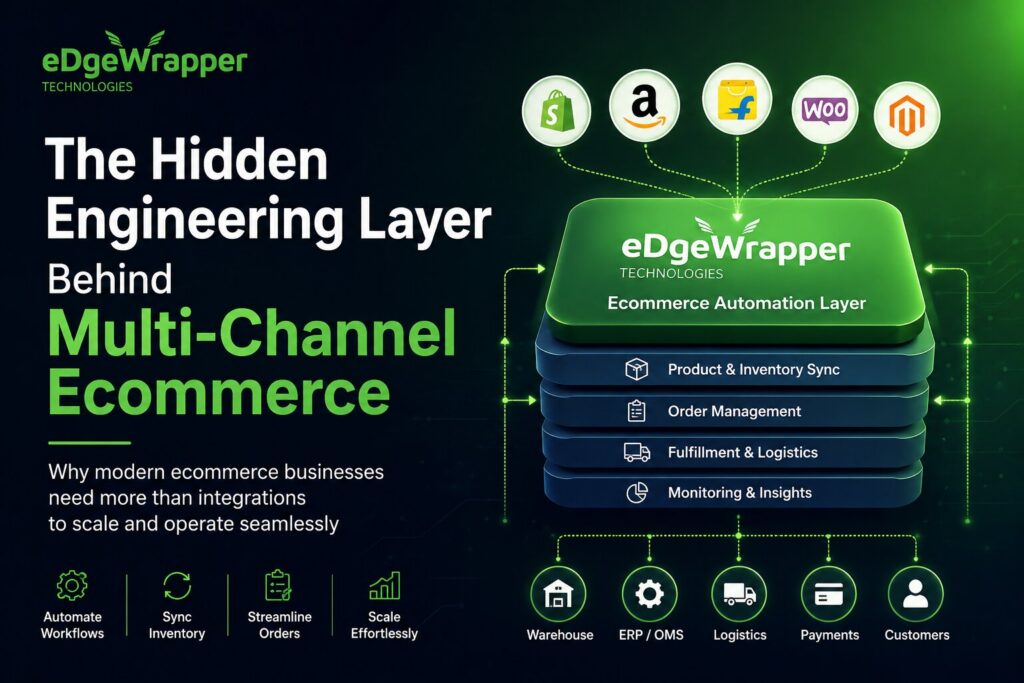
The Ecommerce Automation Layer
The hidden engineering layer sits between individual ecommerce platforms and the business’s operational processes.
Shopify
Amazon
Flipkart
WooCommerce
Magento
Amazon
Flipkart
WooCommerce
Magento
⬇
⚙️ Ecommerce Automation Layer
⬇
ERP / Warehouse
Logistics
Logistics
Instead of every system operating independently, the automation layer coordinates the flow of information and actions.
Why Centralized Ecommerce Automation Matters
Without centralized automation, every new channel creates another operational surface — another dashboard, another API, another order format, another inventory system, another set of failures to manage.
❌ Instead of: “Which platform should we check?”
✅ Teams ask: “What is the status of this order?”
They move from platform-based operations to workflow-based operations.
Observability: The Missing Piece
Automation without visibility can create another challenge. A strong ecommerce automation system should provide visibility into:
📦 Order status
Processing, completed, failed, waiting
📊 Inventory status
Synchronized or discrepancies
🔗 Integration health
Connected platforms responding
⚠️ Workflow failures
Which workflows require attention
🔄 Retry status
Operations automatically retrying
Instead of discovering a problem after a customer complains, the business can identify the failed workflow earlier.
EdgeWrapper: Connecting the Ecommerce Workflow
EdgeWrapper helps businesses connect ecommerce platforms and automate workflows across Shopify, Amazon, Flipkart, Magento, WooCommerce, WordPress, logistics and operational systems. The focus is not simply on creating individual API connections — it is providing a centralized automation layer that coordinates ecommerce processes.
Products
Inventory
Orders
Fulfillment
Tracking
Exceptions
Inventory
Orders
Fulfillment
Tracking
Exceptions
With an ecommerce hub approach, businesses can build workflows for every aspect of multi-channel operations.
From Integration to Workflow Automation
There is a major difference between these two models.
🔌 Traditional Integration
Shopify → API → Internal System
Simple point-to-point connection
⚡ Workflow Automation
The same order runs through the full validate → map → check → notify → ship → track → sync sequence covered earlier — but as one coordinated process rather than a single API call, with failures caught and retried at every step instead of silently dropped.
End-to-end business process orchestration
The second model is closer to how the business actually operates. The future of ecommerce integration is moving toward workflow automation and orchestration.
Building an Ecommerce Architecture That Scales
A scalable ecommerce architecture should be designed for the business the company wants to become — not just today’s order volume.
Shopify + One Warehouse
Shopify + Amazon + Flipkart
+ WooCommerce + ERP + Multiple Warehouses + Multiple Logistics
Shopify + Amazon + Flipkart
+ WooCommerce + ERP + Multiple Warehouses + Multiple Logistics
If automation is built into the architecture, additional channels become part of standardized workflows. The business can grow without allowing operational complexity to grow at the same rate.
The Business Value of Ecommerce Automation
The benefits of ecommerce automation extend beyond engineering.
📉
1. Reduced manual work
Routine tasks automated
👁️
2. Better inventory visibility
Reduced discrepancies
⚡
3. Faster order processing
Automated predefined workflows
✅
4. Fewer operational errors
Reduced manual data entry
📈
5. Better scalability
Add channels without increasing manual work
🚨
6. Faster exception handling
Failures detected and routed for action
🏢
7. Centralized operations
Clearer view across multiple platforms
The goal is not automation for its own sake — it is to create a business that can operate more efficiently as it grows.
Multi-Channel Ecommerce Is Becoming an Engineering Discipline
Ecommerce used to be primarily about building a storefront. Today, the storefront is only one component of the system.
Customer Experience
Commerce Platforms
Marketplaces
Inventory
Order Management
Warehouse
Logistics
Automation
Data
Commerce Platforms
Marketplaces
Inventory
Order Management
Warehouse
Logistics
Automation
Data
The companies that scale successfully will need to think about all of these components as one connected ecosystem. Ecommerce teams increasingly need to think like technology teams — and technology teams need to understand business operations.
The real competitive advantage is not simply having more integrations — it is having a system that makes those integrations work together reliably.
The Future: One Connected Commerce Operation
The future of multi-channel ecommerce is not about managing every platform separately — it is about creating a connected operational environment.
A customer purchases from Amazon while the business automatically:
Receives the order
→
Validates the transaction
→
Maps the SKU
→
Checks inventory
→
Updates other channels
→
Notifies fulfillment
→
Creates shipment
→
Updates tracking
→
Completes the workflow
Receives the order
→
Validates the transaction
→
Maps the SKU
→
Checks inventory
→
Updates other channels
→
Notifies fulfillment
→
Creates shipment
→
Updates tracking
→
Completes the workflow
Not simply fewer clicks. Not simply more API integrations. But a business operation where systems coordinate with each other automatically.
The Hidden Layer Is the Scalable Layer
Multi-channel ecommerce may look simple from the outside. But behind that experience is a complex network of platforms, APIs, databases, warehouses and logistics providers. The difference between a fragmented ecommerce operation and a scalable one often comes down to the layer connecting these systems.
Integration
Data synchronization
Business rules
Workflow automation
Error handling
Monitoring
Recovery
Data synchronization
Business rules
Workflow automation
Error handling
Monitoring
Recovery
For businesses operating across Shopify, Amazon, Flipkart, WooCommerce, Magento and multiple operational systems, building this layer is no longer simply a technical consideration — it is a business scalability strategy.
Build the automation layer behind your ecommerce growth.
EdgeWrapper helps businesses connect ecommerce platforms and automate the workflows that keep products, inventory, orders and fulfillment moving across channels. Start with a free 20-minute workflow audit — we’ll map where your current setup is exposed to silent failures.
EdgeWrapper — The automation layer behind modern ecommerce operations.
